


Canadian Liberation March – November 2026

Introduction
The March Route
On 08 November 2026, the 52nd annual Canadian Liberation March was held to honour the sacrifice of the Canadian Army in the liberation of Belgium and the Netherlands during Operation Switchback. The 33 km march follows the progress of the Canadians from Hoofdplaat, Netherlands to Knokke-Heist Belgium.

The route is defined by a collection of 18 markers in the positions shown on the map above.

The current organizers, Danny Lannoy and his nephew Dirk Overstraete, have been involved with the March from its initiation, and continue to complete the trek today.

A contingent of about 40 soldiers participated in the commemorations and march. In addition, there are families and students, all from the military base in Brunssum in the Netherlands. In total, about 90 Canadians participated. They are teachers, young people and students. It really is an international, Canadian day here in Knokke.
A total of 1,747 participants marched the 33 km route this year. In addition, 1,007 people did the shorter walks of 8,10,14 or 19 km. Badges and stickers are given out to all participants, and it is not unusual to see a young person wearing badges for many years. There are numerous scouting and guiding groups participating, often the start to a lifelong engagement. As reported in a VRT news article, Ulrik Cauwels is one of the frequent walkers.

“To my knowledge, it is my 40th participation," says Ulrik Cauwels from Knokke-Heist. He was 12 years old when he ran for the first time and is now 54.
In the beginning, it started playfully in the Scouts. You committed to something and said: 'We are going to do a nice march.' That was fun at age 12, when you didn't quite realize the deeper meaning yet. Later, I did my military service with the paratroopers, including in Rwanda and Somalia. Only then do you truly realize what liberation means and what it entails that we were liberated from the Nazi Germans here back then.
JFC Brunssum
We had always wondered why the Canadian Military Contingent was from Allied Joint Forces Command (JFC) Brunssum. Teacher Rachel asked Danny during the walk and got the story. Soon after the walk started the group thought it would be appropriate to have Canadian Military participation so asked the Canadian Embassy. The Embassy detailed the Canadian Base in Lahr, Germany to march and the first year one officer and a few soldiers participated. They had a great time and told the committee not to ask the embassy again as they wanted to come back. They participated every year until the base was closed in 1994. At the time, one of the former Lahr marchers was at JFC Brunssum and volunteered their members who have been marching ever since. The main contingent is from JFC, with a few spots given out to other Canadians in the Area.
Similarly, the AF North Teachers started with a single representative and the participation has increased dramatically in recent years.
Teachers Rachel, Christine and Whitney all from the class of 2027, have done the full 33km for all four years of their tenure.

Battle of the Scheldt
The British 30 Corps had captured the port of Antwerp on 04 September 1944 but were ordered to stop at the Albert Canal. The Germans occupied both sides of the Scheldt Estuary, a total length of 50 km, so the Canadians were given the task of clearing the Estuary so that Allied shipping could deliver supplies into the port of Antwerp.
Second Division of the First Canadian Army cleared the northern bank of the Scheldt, the Third Division the Southern bank as part of Operation Switchback, and the Fourth Canadian Armoured Division pushed North of Antwerp.

Details of the fighting by the Second and Third Division are presented in the posts:
Operation Switchback
Operation Switchback was a fierce and critical military offensive conducted during World War II as part of the broader Battle of the Scheldt. Lasting from October 6 to November 3, 1944, its primary objective was to clear German forces from the Breskens Pocket—an area located south of the Western Scheldt estuary, trapped between northern Belgium and southwestern Netherlands.
Clearing this pocket was essential to opening the vital deep-water port of Antwerp to Allied shipping, which was desperately needed to supply the advancing armies pushing toward Germany.
The operation was spearheaded by the 3rd Canadian Infantry Division. Historians frequently describe the Breskens Pocket as some of the worst terrain encountered by soldiers during the war. Consisting of reclaimed lowlands (polders), the area was characterized by a flat grid of soaked agricultural fields bordered by deep drainage canals and high, steep dikes (5 to 8 meters tall). Heavy October rains and deliberate flooding by the Germans saturated the terrain, making movement nearly impossible for infantry and entirely prohibitive for standard tanks.
Canadian forces suffered 2,077 total casualties (killed, wounded, and missing) while clearing the Breskens Pocket.

Friday Remembrances
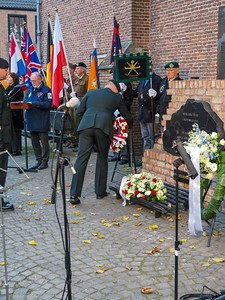
On Friday, the Canadian Military Contingent paraded in the Netherlands cities of Eede, Aardenburg and Sluis with the For Freedom Museum Pipe Band. There were speeches, wreath and flower presentations and large local crowds at all locations.
A group of WW2 reenactors along with their vehicles accompany the contingent to the memorial sites.

Eede
The memorial in Eede is shown. After the Canadians crossed the Leopold Canal, the Germans withdrew from Eede destroying many buildings for better fields of fire. Over 90% of the buildings in the town were destroyed.

Local Children in front of the Bren Carrier at the memorial.

Aardenburg
Aardenburg was liberated on 19 October by the Highland Light Infantry. The town was almost completely destroyed with only 35 of 1000 buildings undamaged. The memorial ceremony was held at the Aardenburg Communal Cemetery, where a Lancaster bomber crew is buried. The Lancaster ND919 from 75 (New Zealand) Squadron was part of a 110 aircraft raid on the Leuven/ Louvain railway yards. Most of the bombing hit the railway workshops and storage buildings rather than the yards. In the raid 4 Lancasters, including ND919, were lost. ND919 was attacked by a night fighter and exploded in mid air. The crew consisting of 2 Canadians, 1 Australian and 4 Brits, were buried in the Aardenburg cemetery in a communal grave.

Memorial service at the grave site.

Sluis
Sluis was liberated on 01 November 1944 by Le Regiment de la Chaudière. Weeks of artillery shelling, mortar fire, and air attacks struck the town during the fighting in western Zeeuws-Vlaanderen. Many buildings were damaged or destroyed before Canadian troops entered the area. The historic belfry (Belfort), the only medieval belfry in the Netherlands, was heavily damaged by the fighting in October 1944 and had to be restored after the war, with restoration completed in 1962.
Sluis is a beautiful, quiet city today.

The memorial in front of the belfry.

The wreath laying ceremony.
The day is capped off by a reception for the Canadian Military participants. After school on Friday, the bus with Teachers, Students and Family joined the military folks. Drinks, snacks and the obligatory Buscuterie fuelled the merriment for the trip.
Saturday Remembrances
Resistance Monument
Saturday morning starts off with a march from the Hotel to the Resistance memorial in Knokke, with the For Freedom Museum pipe band and Canadian Military Contingent leading the way and the AF North teachers, students and families following behind. Hotel Prince Baudouin is the Canadian headquarters for the march and is appropriately decked out.
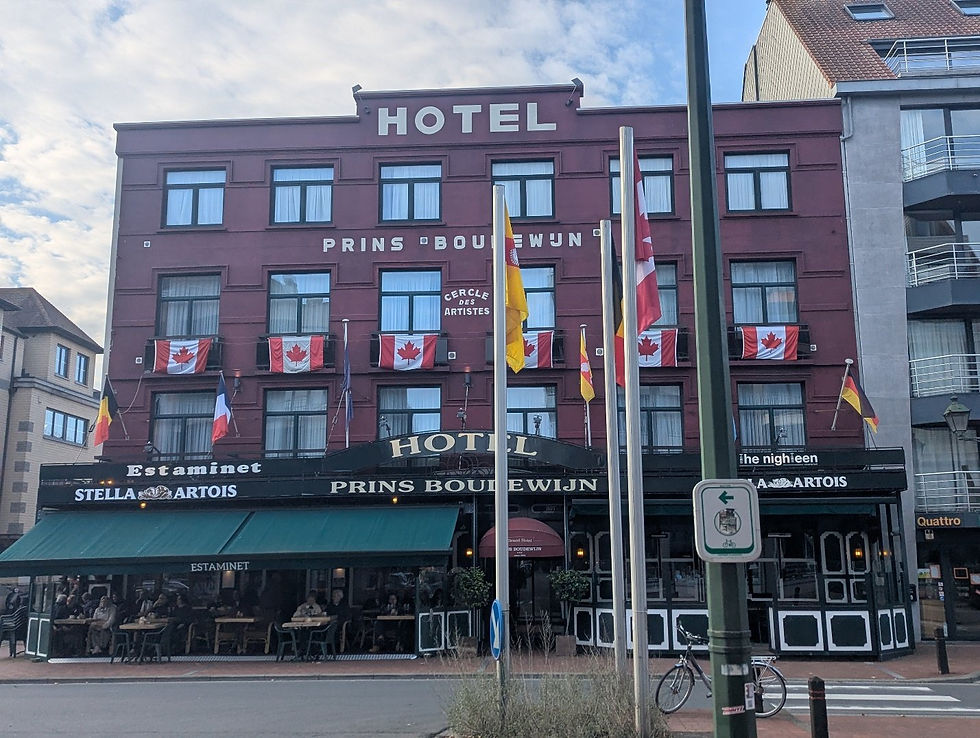
Knokke is a resort town with condos lining the main street. It is always very powerful to see the number of Canadian flags and the people on their balconies supporting the march.

The memorial bears the emblems of the Secret Army, the phrase T VERZET (the Resistance) and the Battalions of the 9th Infantry Brigade, 3rd Canadian Division:
· The Highland Light Infantry,
· Stormont, Dundas and Glengarry Highlanders and
· the North Nova Scotia Highlanders
who liberated the town of Knokke on 01-02 November.
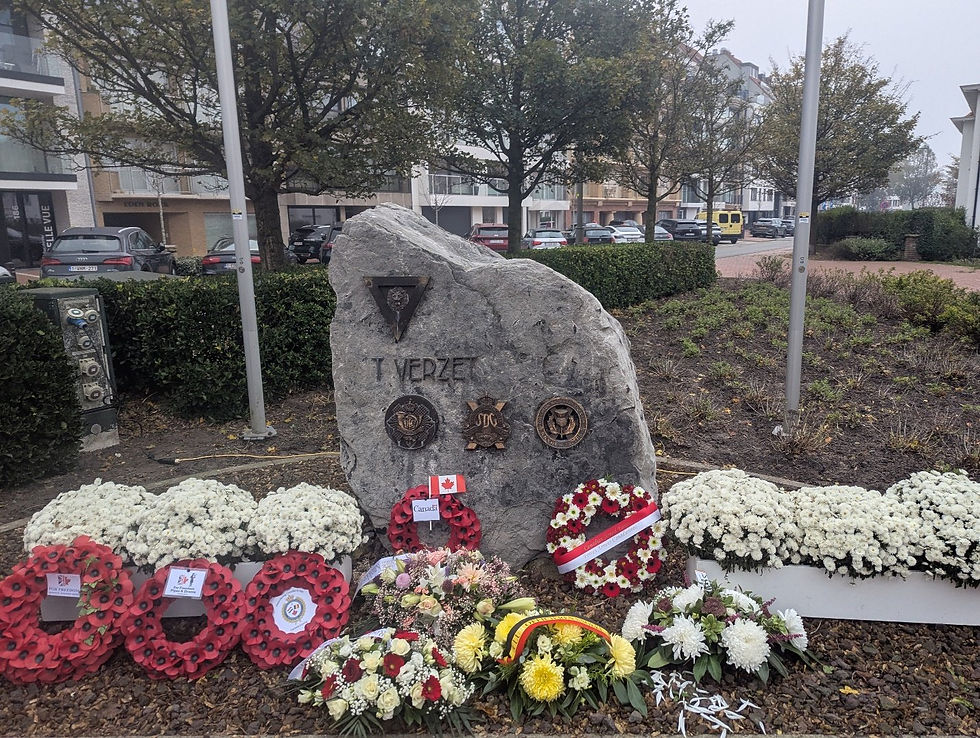
At each stop, the local dignities make heartfelt speeches honouring the fallen and expressing gratitude for their liberators. It is very moving as a Canadian to see that 82 years on the remembrance is so strong.
Church Service
This year’s service was at Heilig Hartkert (Sacred Heart Church). The church was built in 1935 and despite the widespread damage in Knokke during the fighting, was relatively unscathed.

The church service features several musical selections that match the theme of remembrance. This year Dire Straits’ Brothers in Arms (1985) was one of the selections. According to Mark Knoffler, the song writer, brothers in Arms acknowledges the soldiers on both sides. The service always focusses my attention on the words, in this case:
Now the sun's gone to hell, and
The moon's riding high
Let me bid you farewell
Every man has to die
But it's written in the starlight
And every line in your palm
We're fools to make war
On our brothers in arms
The service also features the Scheldt Pocket song (2024), written and performed by Robin Langzought. The song was written in 2024 to commemorate the 80th anniversary of the liberation of Belgium and the 50th anniversary of the Canadian Liberation March and honour the sacrifice of the Canadian Soldiers.
The very moving song is written from the Canadian Soldier’s point of view and can be heard here. The key lyrics of The Scheldt Pocket:
There are no winners in a war
So, think about what you’re willing to fight for
There’s only losers in a war
So, think about what you’re willing to die for
The For Freedom Pipe band played Amazing Grace (1779) as always, with a single pipe leading off and the rest of the band joining in on the second verse. It is a moving piece made more striking after the service of remembrance and gratitude for the liberators.
It’s great to see all of the Red AF North Jackets in the church service.

Adegem Canadian Cemetery
Our next stop was Adegem Cemetery which has 1,109 burials including 848 Canadians. 800 of the Canadians buried here were killed between 09 September and 02 November 1944 in the Battle of the Scheldt. Several of the speakers referred to the Battle of the Scheldt as the Forgotten Battle. It is certainly not forgotten in this area, and I wish more Canadians had the opportunity to experience the Liberation March Weekend so they could better appreciate extent to which the Canadian Sacrifices are still commemorated.

The ceremonies at all of the memorials are moving, but the one at Adegem is particularly poignant as you can feel the energy of the fallen, resting in the company of their comrades.

Adegem is very personal for me as I visit members of my extended family, Christopher Cadeau, Canadian Scottish Regiment and Percy Mervin, Royal Winnipeg Rifles. Their times in the front line are tragically short and sadly typical of many of the stories in the cemetery.
Christoper Cadeau

I have written about Christopher Cadeau previously. He was the cousin of my sister-in-law, Marg Columbus. He joined up at 18, trained as a tanker, but was transferred to the infantry following heavy losses in Normandy. He joined the Canadian Scottish Regiment on 23 October 1944 and was tragically killed 4 days later just outside Cadzland during the Battle of the Scheldt, at the age of 19. He was originally buried in an Orchard outside Hoofdplaat and transferred to Adegem Cemetery after the war. I identify strongly with Christopher as I was the same age as him when I joined the military and with slightly different circumstance in space or time, his story could easily have been mine.
A photo of Rachel visiting Christopher’s grave.

Percy Mervyn

I have previously also written about Percy Mervyn, an uncle of Barb Drury, my oldest sister Diane’s best friend. Percy had just turned 19 when he enlisted in January 1944. He was sent to England in August 1944 and joined the Royal Winnipeg Rifles on 19 September. The Royal Winnipeg Rifles had suffered 700 casualties from D-Day to the end of September out of a 1000-man battalion, so were desperate for more troops. Manpower shortages plagued all units.
To alleviate the shortage, rear areas were scoured for excess personnel that could be sent to the infantry units. Cooks, typists, mechanics, electricians, anybody could suddenly be presented with an infantrymen’s kit and assigned to a rifle battalion. Most of these soldiers had long forgotten even rudimentary infantry skills, so feeding them into the front lines little bolstered a battalion’s fighting ability.
Even reinforcements drawn from the designated infantry pool were proving poorly trained. The Black Watch war diarist reported that most of the reinforcements it was receiving were “a good lot, with all sorts of confidence and a truly aggressive spirit,” but were also “inexperienced and like to dash out to see what is happening if an air burst or shell goes off anywhere in the neighbourhood.” Many were soon “throwing grenades and firing the PIAT for the first time.”
Percy was killed on 10 October 1944 during the crossing of the Leopold Canal at the age of 19, three weeks after joining the regiment.

Nearby Percy is Sergeant JL Hickman, an Engineer who is memorialized at a later stop at Hickmanburg, in Retranchement. Percy is third from the Left and Hickman 6 graves away.
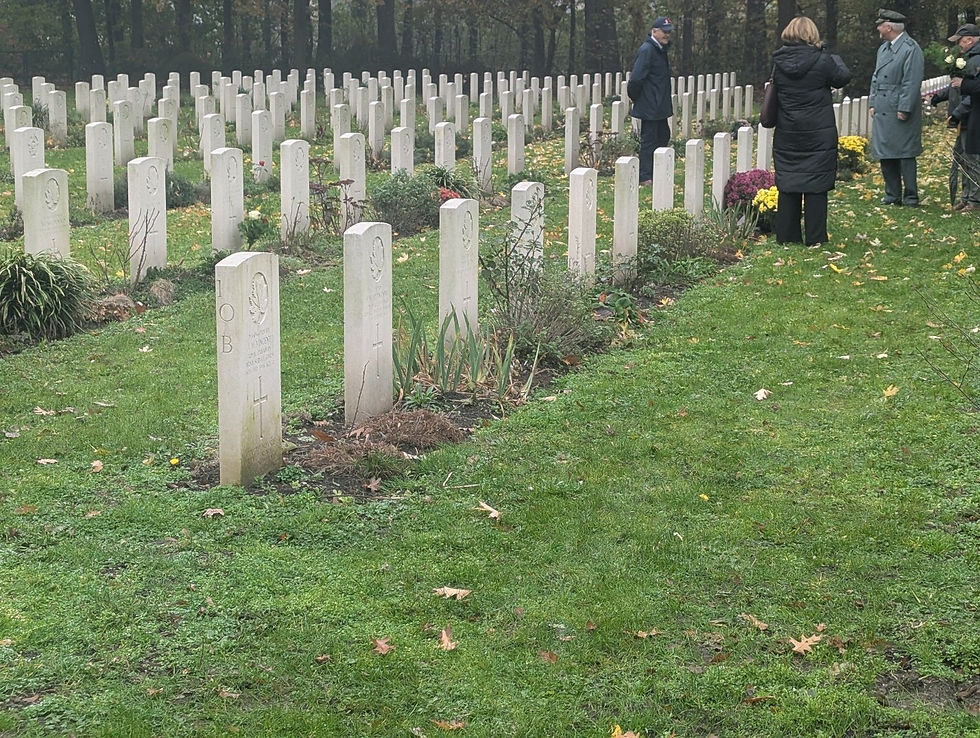

The cross of sacrifice adorned with wreathes.

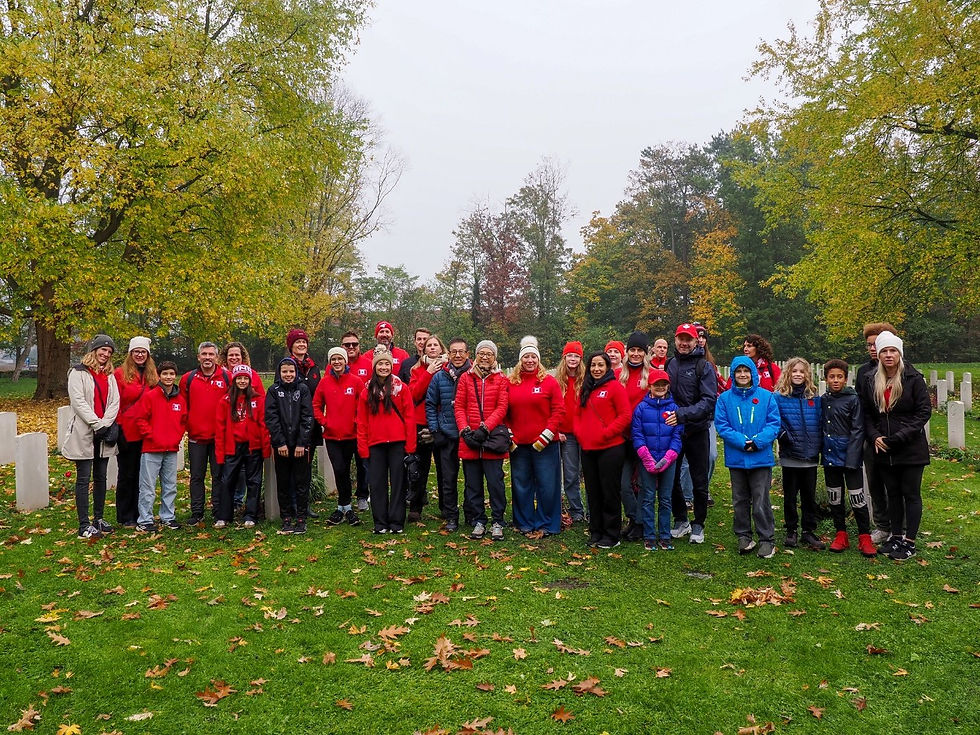
The teachers and families gathered at the cemetery.
For Freedom Museum
The final stop of the evening was at the For Freedom Museum. Danny Lannoy leading the pipe band to the museum. In addition to an excellent museum, they are great hosts, liberally dispensing their delicious For Freedom Beer.

The For Freedom Museum is a private museum run by Danny and Freddy Jones. Their father, Dennis Jones, returned after the war to marry a local Knokke-Heist girl and began to collect artifacts of war. Danny and Freddy initially set up temporary displays before getting access to their current building, the municipal school of Ramskapelle, along with the accompanying town hall from 1876. The building was restored and the museum opened in 2009. A wax mannequin of their father, Dennis Jones, in the uniform he was married in.

This is one of my favourite museums as the 150 mannequins all have wax heads, mostly from the 1920s and 30s, restored by Freddy and a mannequin stylist, giving all of the soldiers a very life like appearance. Many families have donated the uniforms of their loved ones making the collection very personal. All of the Canadian units that took part in Operation Switchback are represented.
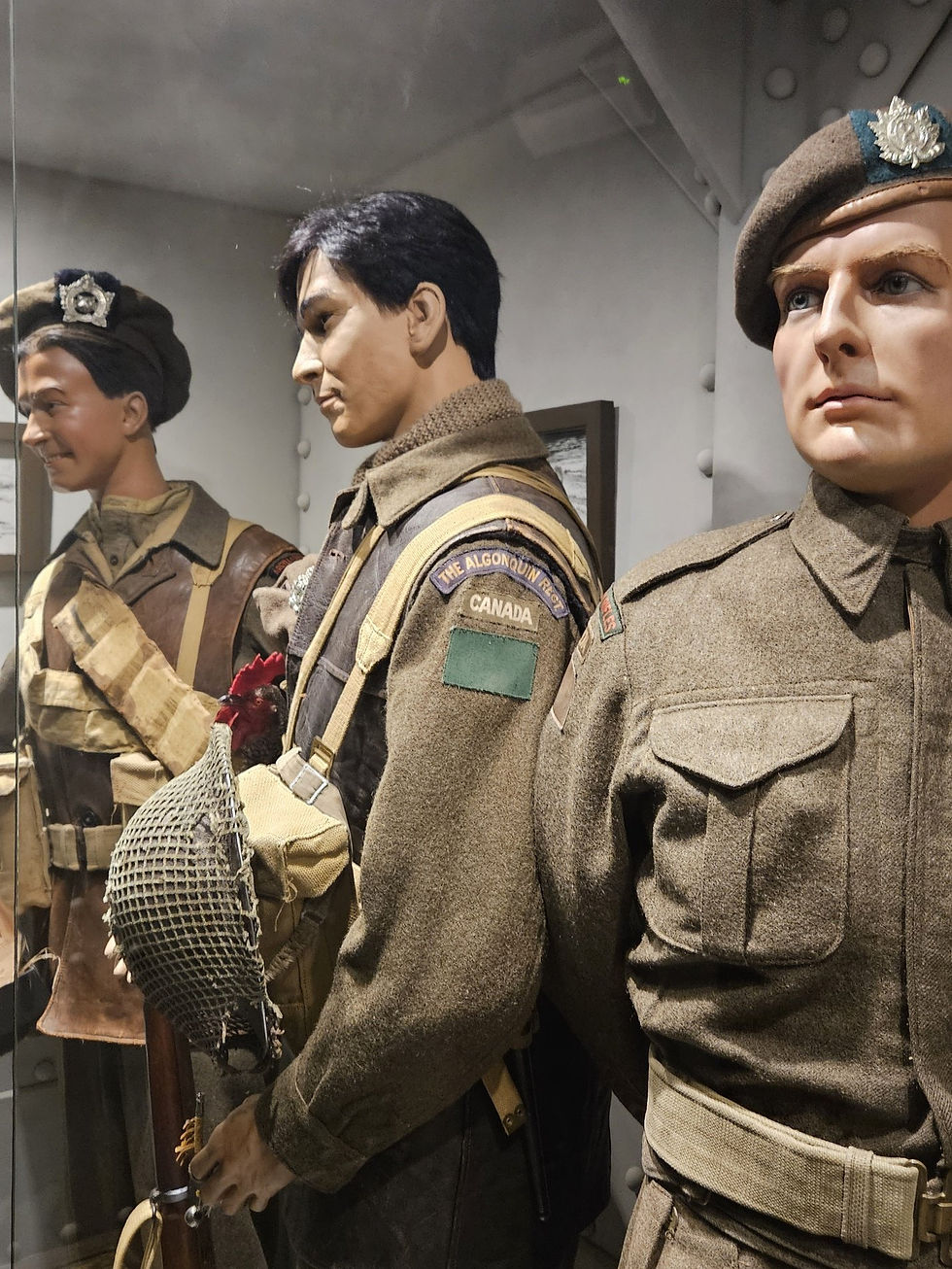
The museum has a number of dioramas showing the soldiers in action. The one that struck me was the crossing of the Leopold canal. The soldiers had to drag the assault boats up the dyke, then down the steep sides, paddle across the canal then up the other side all under withering fire, suffering heavy losses.

Leopold Canal
The initial assault of the Leopold Canal was made by the Algonquin Regiment of 4th Canadian Armoured Division. The Algonquins were to cross the canal on boats and set up a bridgehead so the remainder of 4th Armoured Division could push straight north and capture the port of Breskens to block the German escape route.
At 0530 hours, 13 September, A and B Companies of the Algonquin Regiment, supported by Royal Canadian Engineers, began the assault from Moerkerke. The Algonquins launched in storm boats and Kapok assault floats, paddling across under intense machine-gun and mortar fire from the German 64th Infantry Division entrenched on the far bank. Within minutes, many boats were destroyed; survivors scrambled up the steep north bank to dig in under constant fire.
“Men went into the water up to their necks, dragging their rifles and Bren guns, trying to get footing in the mud. The canal bank was like a wall.”
At the point the Algonquins crossed, the Canal de la Deviation de la Lys runs parallel to the Leopold Canal, so the regiment had to drag their boats down a steep bank, paddle across the canal, clamber up the next steep bank, cross the middle strip, then back down and up the Leopold Canal all under heavy fire.

Of approximately 360 Algonquin soldiers who crossed the canal, only about 90 returned unhurt. The regiment suffered 85 killed, 120 wounded, and 50 captured — an estimated 70% casualty rate in three days.
Historian C.P. Stacey called the Leopold Canal crossing “one of the most desperate small-scale actions fought by Canadian troops in Northwest Europe.”
The next attempt went in on 06 October with the7th Brigade Regina Rifles and Canadian Scottish Regiments attacking. They used Wasp Flamethrowers to reach across the canal to provide a surprise for the early phase of the battle. The flamethrowers operated for 5 minutes and had the north shore of the canal ablaze. Unfortunately, the flames illuminated the boats crossings, and an entire company was lost to machine gun fire.
Much of the area beyond the canal had been flooded, so the 7th Brigade had a limited area to operate in.

The units eventually linked up but were on a very narrow strip of ground and subjected to constant artillery fire and repeated counterattacks.
Shelling and Small Arms fire continued to make it impossible to move about in forward areas except by crawling on the semi flooded ground or in water filled ditches, both of which were littered with German and Canadian dead.

The Canadians suffered 350 killed, 750 wounded and 70 captured during the crossing of the Leopold Canal including Percy Mervyn who we visited at Adegem Cemetery.
Flags on the windmill help situate the museum.

Sunday - The March
Hoofdplaat
The starting point for the march is just down the dike from the Canadian Monument at Biervliet to honour the landing site where the Canadians circumvented the Germans by conducting an amphibious landing to bypass German strong points.

On 09 October 1944, the 9th Brigade North Nova Scotia Highlanders and Highland Light Infantry of Canada regiments made landings in 100 Buffalo Amphibious vehicles just east of Hoofdplaat on the river’s edge.

The Buffalos were tracked amphibious vehicles that carried 30 troops and used their treads as paddles in the water to advance at 8 mph. A photo of the Buffalos landing on the Scheldt bank.

The Canadian Contingent on the beach prior to the start of the march.

The first route marker is built into the Hoofdplaat memorial.

Laying the wreaths at the Hoofdplaat memorial.

The march kicks off. Lots of Red jackets on the move.

Through the streets of Hoofdplaat.

One of the many decorated houses on the route. The sign says
Being a soldier as a side job – that’s quite a feat.

Game recognizes game. Teacher Christine chatting up the locals.

Teacher Shantel and husband Chris trying to explain to student Daphne what “in step” means.

Teacher Christine and Student Daphne Keep on Rocking in the Free World.

There are many locations along the way that offer snacks or a bathroom break to the marchers. The most famous is the Holy Water Lady. Early on in March history, she was told she was not permitted to hand out liquor to the marchers, so she got the liquor blessed by the local priest and handed out Holy Water instead. Teacher Christine bellying up to the Holy Water Bus.

Of course, a little gingerbread helps the Holy Water go down.

The paths run along the top of the dykes. The wet ground shows a small glimpse of the mud the soldiers had to slog through.

Oostburg
The next ceremony was at Oostburg City Hall.

Oostburg was liberated by the Queen’s Own Rifles (QOR) on 25 and 26 October 1944. As is the case in many of the small towns, the memorial to the Canadians is beside the memorial to the locals who lost their lives in the conflict.
The plaques honouring the QOR Liberation of the town. As part of the ceremony, each individual name is read out. This specific commemoration, saying this particular soldier gave his life for the liberation of this town, is a deeply moving reminder of the importance of remembrance.

Similar to many towns in the region, Oostburg was obliterated by Allied bombing and shelling, with 353 buildings destroyed and over 100 civilians killed. Once the Canadians took the town, the Germans relentlessly shelled the town in preparation for counterattacks.

There is never any mention of the destruction of the towns. In an article for Reader’s Digest 20 years after the war, the author asked if there were bad feelings about the destruction, the original organizer of the march just shrugged, and said, it was war. Liberation, no matter the cost, was preferable to living in tyranny and Oppression of the Nazis.
Hickman Bridge
After a quick stop for lunch at Zwin college put on by the residents, the troops moved on to Hickmanbrug in Retranchement. After the liberation of Oostburg on 29 October 1944, the Canadian forces were left with one last obstacle; the drainage canal near Retranchement. The Hickman Bridge, built by the Royal Canadian Engineers, was named by the engineers after their fallen sergeant. After the completion of the bridge, Canadian troops were able to eliminate the last pockets of resistance around Knokke, finally liberating all of Belgium on 2 November. Operation Switchback was thus successfully completed.
Ceremony at the Hickman Bridge memorial.

Right after Hickman Bridge, there is a stop for the Military Contingent to have refreshments with the reenactors who have been driving the WW2 vehicles.
The military is very good at training their personnel. They are trained to have a beer after the march, to march after having too many beers the night before, but the gap in the training is having beer while you march. This became evident in the home stretch of the march. Just before entering Knokke, the route went through a large area of road construction. Suddenly, a few members broke ranks and sprinted off to conduct a critical inspection of the construction porta potty, making sure it was safe for the construction crew to use. Community service inspection complete, they doubled back to the group and followed the band for the final ceremony.
The final rest stop for the civilians before the end is a Beer Barn and facilities, where the slackers like me join for the final 4 km victory lap back into Knokke-Heist. It’s fun to see all the youth groups and collections of long-time walkers and even some Belgian service personnel stop by for a beer before the home stretch.
Knokke
The final ceremony was at the Knokke War Memorial in the centre of town. The troops were led in by Royal Scout Band Sint-Leo from Bruges, Belgium.

The final wreathes were placed in front of the war memorial.

The For Freedom Pipe band who had done yeoman’s work all weekend joined the Scout’s band. They had played Amazing Grace at each ceremony, always with a solo piper for the first verse and the entire band joining in for the remainder of the tune. It is always an emotional tune, but when the excellent young solo piper who was standing directly in front of us started the melody, then both the pipes and drums and brass bands kicked in, the full emotion of the weekend overwhelmed us.

Teachers are only permitted to stay for a maximum of four years, and those on their final march remarked how emotional the entire weekend was.
The ceremony ended with the singing of the Canadian, Dutch and Belgian National Anthems. To sing your National Anthem after a weekend with so many Canadian flags, and heartfelt expressions of gratitude from the Dutch and Belgian is a very powerful moment.
Canadian Military Contingent
Once again, the Canadian Military folks who participated in the weekend did an outstanding job. Over the three days, they attended the equivalent of 10 Remembrance Day Ceremonies with a 33 km march thrown in, always conducting themselves with extreme professionalism, representing the Canadian Armed Forces and Canada in an exemplary manner.
Sunday morning on the bus on the way to the start of the march the Commanding Officer said:
"Regardless of how much you trained for this, you will likely feel some discomfort. Keep in mind that the distance we cover in 6 hours or so we are walking the Canadians covered in 25 days in battlefield conditions. Remember why we are doing this"
It is wonderful to see all services and ranks marching together. Their actions make me extremely proud to be a former service member and prouder to be a Canadian. The importance to the members is highlighted by the fact that there is a competition to be able to participate in the weekend.

Epilogue
Thanks to all those who shared pictures for the post and especially Vlast Pojman, the photographer who documented the weekend for freely sharing his excellent work.
One of the youngest marchers, who at age 7, did 16 km with only the occasional portage on her dad’s shoulders. At the end of the ceremony, she loudly proclaimed: “I’m never going to do THAT again!” I’m betting she’ll be back. After an emotionally and physically draining weekend, the bus ride home was much more subdued than the ride up.
This is a fabulous event, the combination of the seriousness of the ceremonies with the rollicking good time of the March highlights the importance of the Canadian Contribution and the deep regard the residents have for Canadians some 80 years on. All teachers and families should take the opportunity to immerse themselves in the March weekend. I would recommend to all Canadians who have the opportunity to be in Europe to set aside the first weekend in November to participate in this outstanding commemoration.


Great presentation. Brought home many feelings about what was sacrificed for us by so many. Hats (Barrett’s) off to You, Rachel and all who went the extra mile to remember our fallen and those who made it home.
Thanks. The march is definitely a highlight of my visits
Even though I have read your 3 previous posts on this march, it still is great to read and to feel the excitement. I bet both you and Rachel will be back for future marches. Well done.